Direct Mail & Digital Marketing Insights

Ideas, tactics, and straight talk from Direct Mail Specialists and Ascend Digital.
Light on fluff, heavy on what actually gets campaigns mailed, tracked, and performing.

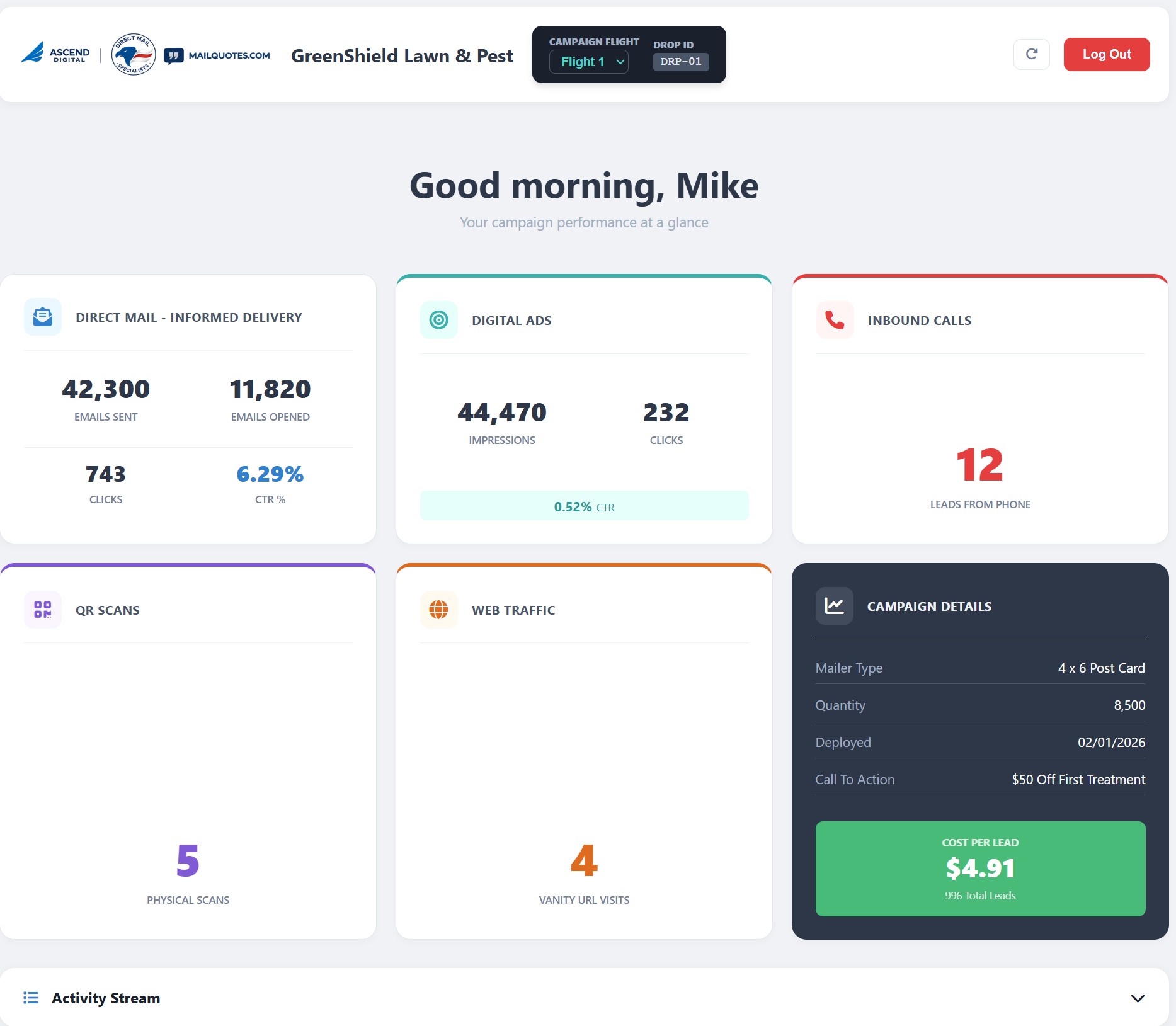
Campaign attribution dashboard showing five tracking signals

"We Mailed 50,000 Postcards. Good Luck." — Why That's Not Good Enough Anymore

February 2026 – Here's how most direct mail campaigns end: someone at the print company hits "go," 50,000 postcards land in mailboxes over a few days, and then… silence. Maybe you get a PDF report a month later with delivery confirmation. Maybe you don't.

Either way, the conversation is usually the same: "We mailed them. Hopefully it works."

That's not a strategy. That's a coin flip with a postage bill.

The real problem isn't the mail. It's the blind spot after it lands.

Direct mail actually works. It cuts through the noise in ways that digital alone can't. People hold it, read it, stick it on the fridge. The response rates are measurably higher than email for most industries.

But here's where most mail companies drop the ball: the moment the postcards leave the facility, they wash their hands. You're left wondering whether your $5,000 or $50,000 investment actually moved the needle, and the only "proof" you get is a vague sense that the phone might be ringing a little more.

That's the blind spot. And it's the reason smart marketers have been skeptical of direct mail — not because it doesn't work, but because nobody could show them that it did.

What if you could actually see what happened?

That's exactly why we built the Ascend Signal Hub. It's a live campaign attribution dashboard that tracks five independent signals from every campaign — not estimates, not projections, not "we think it's working." Real data. Updated daily. Accessible from your phone or laptop anytime.

Here's what you see when you log in:

Signal 1: USPS Informed Delivery

Before your postcard even hits the physical mailbox, USPS sends a digital preview to subscribers. We track how many of those emails were sent, how many were opened, and how many people clicked through. This is the earliest indicator that your campaign is generating interest — sometimes before the mail even arrives.

Signal 2: Digital Ad Impressions & Clicks

We run geofenced digital ads to the same audience your mailer targets. You see exactly how many impressions were served, how many people clicked, and the click-through rate. This isn't a separate campaign — it's reinforcement that keeps your offer in front of people while the mail is still warm.

Signal 3: Inbound Phone Calls

Every campaign gets a dedicated tracking number printed on the mailer. Every call to that number is logged automatically — no manual tallying, no asking "how did you hear about us?" You see the count in real time.

Signal 4: QR Code Scans

The QR code on your mailer doesn't just link to your website. It routes through our tracking system first, so every scan is recorded and attributed to the specific campaign. You know exactly how many people picked up the postcard and took action.

Signal 5: Vanity URL Visits

Not everyone scans a QR code. Some people type in the web address. Your custom vanity URL (like TrySmithDental.com) is tracked the same way — every visit is logged and attributed to the campaign.

All five signals. One dashboard. One number that matters.

At the bottom of every dashboard is the number that makes or breaks a campaign: Cost Per Lead. We take your total campaign investment, divide it by the total leads generated across all five signals, and give you a number you can actually compare against your other marketing channels.

No guessing. No "we think it worked." No waiting 30 days for a PDF that tells you what you already suspected.

Transparency goes both ways

Here's the part most mail companies would never agree to: the Signal Hub shows you everything — including when a campaign isn't performing. If the QR scans are flat, you'll see it. If the calls aren't coming in, you'll see it. If the digital ads are getting impressions but no clicks, you'll see that too.

We're fine with that. Because when you can see what's not working, you can fix it. Swap the offer. Adjust the audience. Tighten the landing page. That's how campaigns get better — not by hoping, but by knowing.

And when a campaign is working? The dashboard makes the case for scaling better than any sales pitch ever could. The numbers speak for themselves.

The old way vs. the new way

The old way: Mail company prints and ships. You wait. You hope. Maybe you get a delivery report. You never really know what worked.

The new way: Your mail drops. Within days, five independent tracking signals start feeding your live dashboard. You see who's opening, clicking, calling, scanning, and visiting. You know your cost per lead before the ink on the invoice is dry. And you have everything you need to decide: scale it, tweak it, or kill it — based on data, not gut feel.

Where to go from here

If you're tired of writing checks and crossing your fingers, we'd love to show you what the Signal Hub looks like with real campaign data in it. It takes about five minutes.

You can reach out to the team to request a live walkthrough, or start with an Instant Quote to see what a tracked, attributed campaign would look like for your business.

Direct mail works. But "good luck" isn't a reporting strategy. It's time to see what's actually happening.

Direct Mail Specialists is the direct mail marketing branch of Mailquotes.com, LLC. We provide direct mail and integrated direct mail + digital campaigns throughout the U.S., Canada & Puerto Rico. Call us at 407-348-7400.
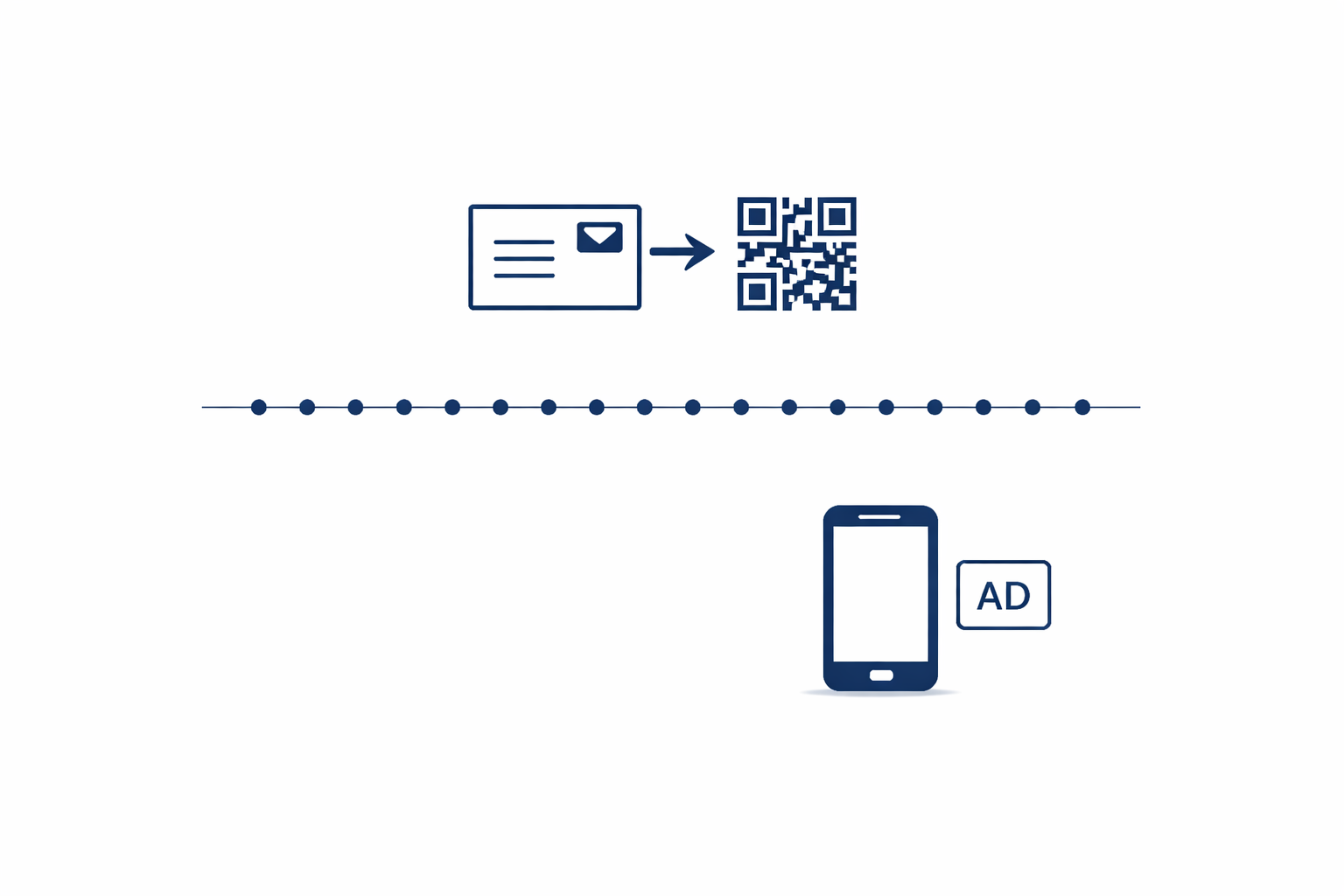


Direct mail plus digital follow-up playbook

The 14-Day Direct Mail + Digital Follow-Up Playbook (So You Don’t Waste Your Mail List)

January 2026 – Direct mail works because it creates a real moment. But most campaigns still die the same way: the mail lands… and then nothing happens online. No follow-up. No reinforcement. No easy way to capture the “I’m interested” traffic while it’s warm.

If you’re already spending money to get in front of a household, squeezing more response out of that same audience is usually the cheapest win available. And if you’re still validating your numbers, start with an Instant Quote so you can build a test that fits your budget before you scale.

Step 0: Before you mail anything, decide what “response” means

Pick one primary action and commit to it:
• A short form fill (quote request, consultation request, “get pricing”)
• A phone call (with a dedicated tracking number)
• A checkout / purchase (if you’re e-commerce)

If your mail asks people to do three things, they usually do none. One offer, one action, one destination.

Step 1: Build a landing page that doesn’t ramble

Your website homepage is not a landing page. A direct mail landing page should be “stupid-simple”:
• A headline that matches the mail offer
• 3–5 bullet points that answer “why you”
• Proof (logos, reviews, short testimonial, before/after)
• One call-to-action above the fold

If you want higher conversion, tighten the path. Don’t add paragraphs.

Step 2: Make attribution unavoidable

If you can’t tell where leads came from, you can’t scale intelligently. At minimum, use two of these:
• QR code → dedicated landing page
• Short URL (unique to the campaign or offer)
• Dedicated tracking number (unique to the mail drop)

A quick real-world example: on a recent drop, the short URL captured 38% of total responses, while calls accounted for 22%. Both were trackable, which made the next decision (repeat vs. adjust) straightforward.

Step 3: Start digital before the mail hits homes

Most people do this backwards: they wait for the mail to land, then they “start ads.” Better approach: have digital running as the mail is in transit. When the first scans, visits, and searches happen, you’re already present.

What to turn on first:
• Retargeting (display/social) to reinforce the same offer
• Branded search coverage (so you own your name when curiosity spikes)
• Optional: tight non-branded search test if the funnel is clean

The 14-Day Timeline
Days 1–3: The curiosity window

This is when people see the mail, scan it, and look you up.

Monitor:
• QR scans / landing page sessions
• Form fills / calls
• Brand searches and click-through rate
• On-page behavior (bounce rate, time on page)

Optimize quickly:
• Landing page headline and CTA clarity
• Form length (shorter usually wins)
• Call tracking setup (recording / routing)

Days 4–7: The reminder phase

A lot of response happens after the first exposure. This is where digital earns its keep.

Run:
• Retargeting creative that mirrors the mail (same offer, same tone)
• A second message angle (same offer, different “why”)

Don’t change the offer online. Don’t send people to your homepage “to explore.” This is follow-through.

Days 8–14: The decision window

If your offer is solid, this is where the fence-sitters tip.

Add:
• Light urgency cue (deadline, capacity, bonus) without being scammy
• Proof-heavy creative (reviews, outcomes, guarantees)
• If calls matter: “Call now” during business hours, with tracking

The simple scoreboard you actually need

Track what you trust:
• Pieces mailed
• Total responses (calls + form fills)
• Cost per response / cost per lead
• Close rate (even if it lags)
• Revenue influenced (when available)

Where to go from here

If you want a clean starting point, use our Instant Quote tool to price a test drop quickly, then we can help you map a simple mail + follow-up plan that matches your timeline.

Direct mail creates intent. Digital keeps it alive long enough to convert.

Direct Mail Specialists is the direct mail marketing branch of Mailquotes.com, LLC. We provide direct mail and integrated direct mail + digital campaigns throughout the U.S., Canada & Puerto Rico. Call us at 407-348-7400.

Direct mail and digital marketing insights

How to Test Direct Mail (and Layer Digital) Without Blowing Your Budget

December 2025 – Direct mail has this reputation of being “expensive” and “high risk.” In reality, it’s only scary when you skip the testing and jump straight to a giant national rollout with a wobbly offer and no tracking.

The good news? You can test smart, start small, and still look like a hero to your leadership team or clients. Here’s a simple way to think about it.

Step 1: Start with a realistic test quantity

For most industries, a good starting point is 2,000–5,000 pieces. It’s big enough to give you statistically useful results, but small enough that you’re not gambling the entire marketing budget on one idea.

In that test, you’re not trying to optimize everything. You’re answering a few basic questions:

  • Does this offer actually get people to respond?
  • Is the audience/targeting directionally right?
  • Are we in the right ballpark on cost per response or cost per lead?
Step 2: Make your response path stupid-simple

Every extra step kills response. Your mailer should point people to one primary action:

  • Scan a QR code that lands on a tight, focused landing page, or
  • Call a dedicated tracking number, or
  • Visit a short, memorable URL that’s unique to the campaign.

The key is attribution. If you can’t tell which responses came from which campaign, it’s just “nice mail” instead of a measurable channel.

Step 3: Track like a grown-up (even if the budget is tiny)

You don’t need a huge martech stack. You just need a small set of numbers you trust:

  • Total pieces mailed
  • Total responses (calls, form fills, quote requests)
  • Leads or opportunities generated
  • Closed deals and revenue (even if it lags behind)

That’s enough to start comparing cost per lead and cost per sale against your other channels.

Step 4: When the test works, that’s where Ascend Preferred comes in

Once a test shows promise, the next question is usually: “Can we squeeze even more out of this?” That’s where we start layering in digital on top of the mail.

With our Ascend Preferred approach, when you scale to higher volumes (typically 10,000 pieces or more), we can:

  • Improve your print and postage economics at those higher quantities
  • Add retargeting, search, and social campaigns that mirror your mail offer
  • Give you better attribution across channels so you can actually see the lift
Step 5: Don’t skip the “what did we learn?” meeting

The most expensive campaigns we ever see aren’t the ones that “lost money.” They’re the ones where nobody sat down afterwards and captured the learning.

After each test, you should be able to say:

  • What worked better than expected?
  • What didn’t move the needle?
  • What will we absolutely do again next time?
Where to go from here

If you’d like to see what a test plan might look like for your business – including quantities, rough budgets, and how digital could plug in – we’re happy to talk through it.

You can:

Either way, you don’t have to guess alone. That’s what we’re here for.

Direct Mail Specialists is the direct mail marketing branch of Mailquotes.com, LLC. We provide direct mail and integrated direct mail + digital campaigns throughout the U.S., Canada & Puerto Rico. Call us at 407-348-7400.